30 January, 2015

Social Work All Inclusive

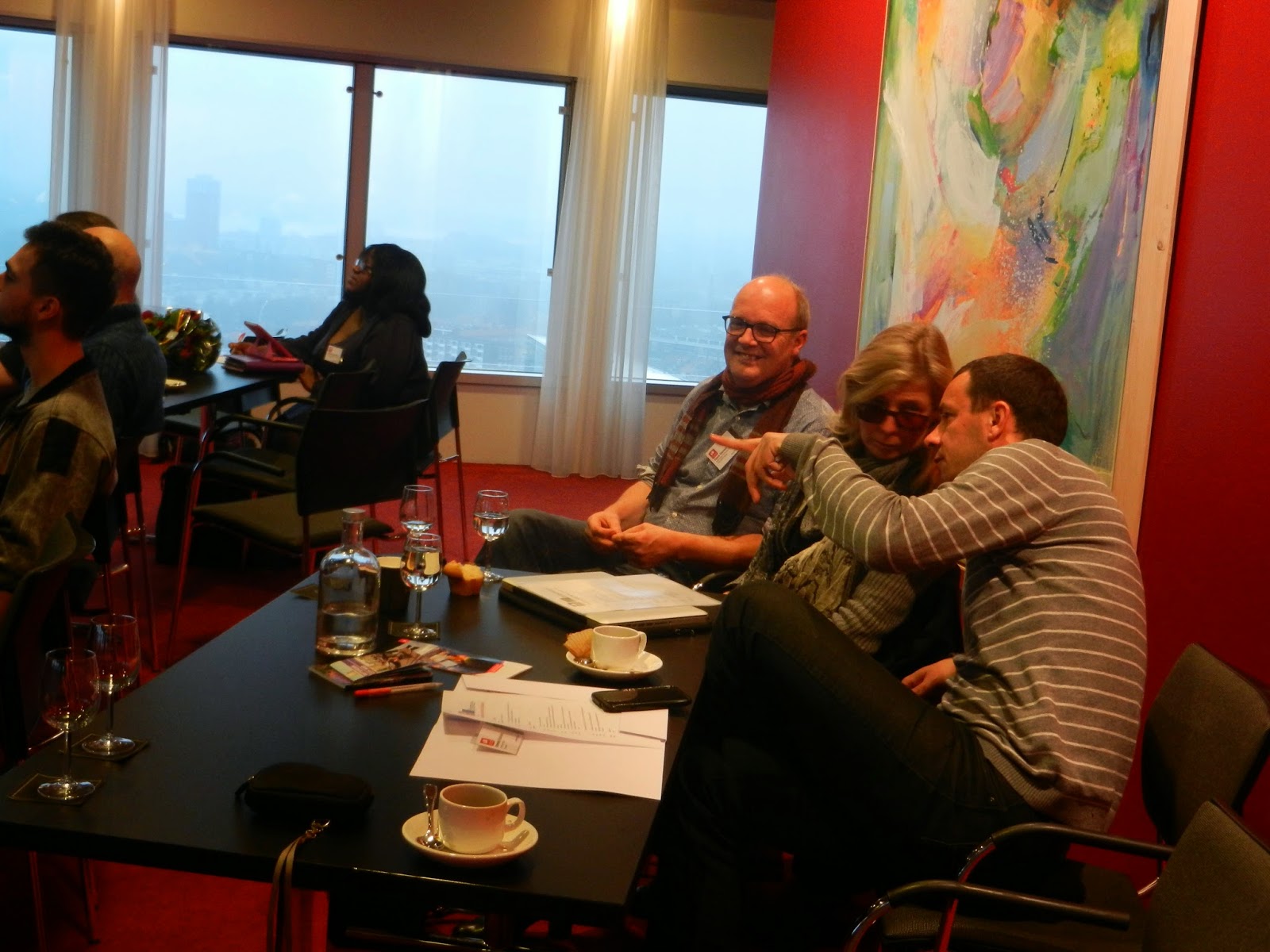
Last week the School of Social Work welcomed a large group of youth workers from around Europe to exchange and discuss good practices, projects and programmes on inclusion. It was senior lecturer Hans Donders from the Cultural Social Work programme who had invited a variety of European partners in order to explore the universal components that turn projects in this field into successes.
All over Europe (youth) organisations plan and implement different projects to help underprivileged groups of youngsters to find their place in society. Some prove to be successful, some fail. Curious to find out the secret behind successful projects on inclusion or combating exclusion, Hans wrote a project application for a European conference of a week to be held in Rotterdam in order to discuss this issue face to face. The common goal was to identify a number of effective tools and methodologies to enhance youth work practices and subsequently share these in the respective organisations and countries. With the results and conclusions from the Rotterdam conference, new activities are to be planned and implemented in the next few months as try-outs. The outcome of the project as a whole will take the shape of a manifest (a.o.) and will become available towards the summer of 2015.
What made the conference special, was the involvement of all year 2 students of the Cultural Social Work programme. They were either hosts, presenters or facilitators. Their active involvement and enthusiasm in working with the international visitors contributed largely towards the success of the conference.
For the students, the conference was an excellent opportunity to practise their intercultural skills and English language skills. All students had been working steadily towards this special week: on the one hand in a minor programme called Art in Social Action, on the other hand via all kinds of project activities. For these students, their international experience isn't over yet ! For within a week's time they'll be leaving for Palermo for the annual year 2 study visit. In that sense, the year 2 programme has managed successfully to gradually take students out of their comfort zones: first within the safe environment of the school, next outside their own country, but always under the supervision of their lecturers.

Speaking to one or two students today, it became crystal clear that the conference had had a large impact on them and had definitely made them eager for more international steps and experiences.
So is it mission completed ? Yes, definitely: the result is that students have been able to get hands on experience in what it means to collaborate internationally on youth issues, thereby enhancing their international views on the social work profession. We'll know more about the longer terms effects within a few months, when students choose their placements for year 3 or possibly within a year, when students can choose to attend a minor programme abroad.
Meanwhile the international partnership will steadily work towards the final output.


This project has been funded with support from the European Commission. This blog post reflects the views only of the author, and the Commission cannot be held responsible for any use which may be made of the information contained herein.


27 October, 2014

Learning about Brussels youth work practices

Via an announcement in the NJI newsletter my attention was drawn to a study visit in Brussels mid October.  The focus was on visiting youth projects and organisations  in the metropolitan area and learn about the way they tackle the many issues surrounding young people growing up in a super-diverse big city.  It was the Flemish international youth agency JINT (an NJI counterpart ) that hosted the visit. JINT not only supports young people to experience international exchanges but also inspires youth workers to take steps towards international cooperation.  
After an initiation into the many Brussels complexities of local, regional and national government layers and the funny video Belgium for Dummies, we went on our way to TracĂ© Brussel, our first stop at their “work shop” / “werkwinkel”.  After getting to know the basic facts and figures of the greater Brussels region we learned about the EU initiative of the Youth Guarantee, an ambitious and innovative policy for youth employment targeting a clear result: every young person must get a good labour market opportunity within 4 months. This requires investment but also structural changes in how young people are supported in moving from school to work. Vincent Verrydt briefed us about the  four projects TracĂ© Brussels set up to address youth unemployment issues, namely Jump to work, Company visits, Student jobs and Make IT work  .
Our second visit took us to Anderlecht where Tonuso operates its KLIK project, an alternative educational path  for youngsters aged 12 to 18 years of age for whom there is limited or no school perspective or for whom going to school is difficult for a variety of reasons. In the project youngsters are supported via a special arrangement on a voluntary basis. It kicks off with a common exploration during a so-called round table with all parties concerned (the youngster in question, school, parents, plus sometimes representatives from a neighbourhood centre a.o.). The goal is to find out what would work best to break the negative circle in the given situation. Youngsters are encouraged to find their own interests and work on their individual talents in a specific environment that matches their interests, outside school, in a voluntary work setting . All this is put into place and closely monitored by the KLIK project staff.  If all goes well with the tailor made trajectory for the youngster, there is a final round table in which the “harvest” of the alternative path is presented: a list of talents and competences which can support the youngster on the track back to school (or occasionally to work). Tina Leuyckx told us that the project has brought together a lot of different expertise and is unique in its position in between education and welfare. Annually they support around 100 youngsters.
Our next stop was JES, a youth organisation with a long history that runs in 3 big cities of the Flemish-speaking parts of Belgium: Brussels, Antwerp and Ghent. First we were brought up to speed on the specific challenges of big cities like Brussels with its 180 nationalities and a population of 1,200,000 inhabitants. Similar to Rotterdam, the city grows, rejuvenates and changes colour, with a significant percentage of youngsters leaving secondary school without a diploma, with a high youth unemployment rate and a school system that is not yet sufficiently adjusted to the needs of urban youth. Different however are the language expectations on the side of the employers: multilingual, both French and Dutch in the Brussels metropolitan region, as well as English !
Applying non formal learning methods Jes operates on the crossroads of work, leisure and welfare, for everyone aged between 12 and 30 years of age, for example in their urban laboratory. Liselotte Vanheukelom told us that they provided non formal / informal education and training as well as formal education and training (18 +) for unemployed young people, but also urban adventures, street corner work and participation projects in public space, such as Yota ! In short, the JES DNA is: competences, participation, integrated, innovation, urban. 


screenshot lomap website
This commitment prompted them to develop the Lomap app, the first Flemish smart phone app in youth work. It allows you to go out there and take pictures of things in the neighbourhood you want "to make a statement” about. On the lomap website you can upload the pics, tag them, add comments plus assess them as a success or failure or something in between. The theme can be anything in public space that strikes a youngster as something that needs to be picked up and addressed. As such it opens up a dialogue with policymakers who usually draw up plans behind their office desks instead of out on the streets. An innovative approach to (youth) participation in the big city ! And the good news is that it’s a free tool for anybody to use and share. Another interesting tool they use is C-stick, a digital portfolio (for listing key competences) that is also freely available on www.c-sticks.be in French, English and Dutch. 

After a quick Belgian beer in a self-established youth home called DAR it was time to head back to Brussels Central station to return home. Waiting on the platform I couldn’t anticipate that I would have more than my fair share of (train) time to digest and recap all that I had learned that day: instead of the planned 2.5 hours the train journey lasted more than 4.5 hours .... Still, in retrospect this inspirational visit was more than worth it !

22 September, 2014

New Youth Exchange Opportunity: St'ART

Following up on the findings of research on "Stimulating Youth Entrepreneurship: Barriers and Incentives to Enterprise Start-ups by Young People"  and the 2013 report on the Global State of Youth Entrepreneurship , there is a growing variety of awareness and promotion programmes (in formal as well as non-formal education) facilitating the development of youth entrepreneurship. The driving force behind these initiatives is the strong hope and expectation that the programmes will contribute to the creation of youth employment opportunities by supporting entrepreneurship training specifically geared towards young people. All this against the backdrop of weak economic recovery and escalating youth unemployment.

Becoming an owner of a small enterprise can be an alternative career choice for young people who have an entrepreneurial mindset and also possess the skills, knowledge and confidence to become a successful young start-up.  This is the issue that the upcoming ST’ART youth exchange programme intends to address.

The ST’ART project is a 7 days youth exchange programme to be held in Caltanisetta, Sicily (Italy) next month and will involve 42 young people from a diversity of EU countries, such as Italy, Lithuania, Romania, The Netherlands, Latvia, Bulgaria and the former Yugoslav Republic of Macedonia.

The thematic focus is on traditions in the field of art and culture and thus the programme will entail an exploration of the possibilities to develop entrepreneurial initiatives in this field. The exchange programme will offer a creative space for intercultural dialogue among the participants in order to experiment together how arts education and artistic expression can be effective in empowering young people and engage them in active citizenship around heritage issues.

These are the three major objectives for the youth exchange:
  • To share different experiences and practices in the field of art & culture among young people from different cultural contexts and backgrounds in the EU.
  • To raise awareness among young people of the potential of artistic and cultural traditions as a catalyst for inclusive and sustainable growth.
  • To foster international entrepreneurial initiatives focused on the heritage value of traditions in the field of art and culture.

The project leadership is in the hands of the Italian organisation  PRISM-Promozione Internazionale Sicilia-Mondo, who initiated this exchange week and involved the following partners: Sirvintu Meno Mokykla (LT) , Fundatia ACTIVITY (RO), JASMA (LV), Association "Professional Forum for Education" (BG) , SAM, Republic of Macedonia (MK) and our School of Social Work at Rotterdam University of Applied Sciences (NL).
By joining this initiative we have paved the way for a small delegation of young people from our social work department to participate in this intercultural and international adventure. They will be joined by our staff member Marianne Lindhout who will also take an active part in the programme by leading a number of activities in the programme.


This project has been funded with support from the European Commission. This publication reflects the views only of the author, and the Commission cannot be held responsible for any use which may be made of the information contained there.

23 May, 2014

How to organise stimulating study visits abroad

Recently a blog on the URBACT site gave away the secrets to do just that. From the many European projects that they have run, thematic pole manager Ivan Tosics drew up a blog post to inspire others. Creating opportunities to interact with each other and the hosts, involving all participants, stimulating discussions and initiatives: these are just some of the tips.
Study visits come in all shapes and sizes, with most visits lasting 3 to 5 days and with groups that vary in size from 10 to 15 to 25 people. Many study visits (or study trips or study tours for that matter) amount to a factfinding mission, but it can be so much more than that.
International study visits broaden our horizons, challenge our understanding of ourselves, and help us understand those whose cultures are different from our own. As such they are an invaluable tool in internationalisation. Often visitors prepare themselves by researching the topic of interest in their own country and reviewing their own practice before the actual visit takes place.
Ideally these study visits consist of three components, namely academic, cultural and social exchange. Here are some of the objectives of the majority of study visits: to learn on common themes of interest, to develop mutual understanding, to provide opportunity to reflect and discuss (innovative) practices elsewhere and/or to provide opportunities for networking.
For students' learning the aim is often to compare and to contrast (and sometimes to benchmark). 
A familiar approach to attain these goals is to have site visits to NGOs and other organisations and / or to provide a mixture of expert inputs and discussion.

With the following tips you can take the design and the organisation of a study visit to the next level and provide a positive, enriching and lasting experience.
Here are the 6 "golden nuggets" that are listed in the blog post that was mentioned above:

1. Increase Innovation Potential With Unusual Circumstances
2. Involve Participants In Collective, Playful Actions
3. Organise Dynamic Presentations Of Interesting Practices
4. Ask Partners To Identify Innovative Small Case Practices
5. Make Space For Two-way Knowledge Transfer With The Hosts Of Study Visits
6. Make Room For Micro-consultingask international visitors to act as experts, giving advice on questions of interests to the hosts
Especially, this last tip is definitely an interesting one from an international perspective. For it requires visitors to put themselves in the shoes of the hosts and to relate the topics to the contexts they are familiar with at home. This thinking exercise is bound to produce some incredibly creative ideas that can inspire the hosts to regard the issue at hand in another light and harvest multiple perspectives and solutions from a diverse audience. 

Elsewhere on this blog City as Text was mentioned as an innovative method to uncover and discover urban areas off the beaten track in a surprising manner. The CaT pedagogy emphasizes the strength of experiential or active learning by inviting  participants to "read a city as a text" by having a walkabout through urban districts and debriefing sessions to follow up. This CaT method incorporates a number of these golden nuggets turning a study visit into a successful and stimulating experience. 

20 May, 2014

Speaking of Europe

Adapted from a text by a guest blogger who participated in the YiA training course called Speakers of Europe


Last December Arthur Meenks, Zina Monteiro and Inge Arends participated in a Youth in Action training course that was held in Palermo around the upcoming European elections the following year.

Within the training course we were taught about the rising issues in Europe and the importance of voting. We also received tools to increase the participation of European youth in the upcoming elections in May 2014.

One of our assignments was disseminating the knowledge we gained during the Youth in Action Project.

Last semester one of the subjects within the Cultural Social Work course programme (CMV) was Politics. We decided to take the opportunity to arrange a debate and share our knowledge with our fellow students.

First we gave a presentation on the different parties within the European Parliament. After sharing these basic facts we addressed current issues in Europe and debated on different views and perspectives. This made it easier for students to decide which political point of view they actually have. This was meant to support them to make a decision on how to vote on the 22nd of May.

The last issue we raised during this debate was the question ‘Are you going to vote on the 22nd of May?’ and to our surprise and satisfaction everybody agreed on the importance of voting: mission completed!

The pictures shown here were shot during the training course in Palermo.

As a more permanent outcome of the training course, the team prepared a game-book, which is a free and easy to use tool for anyone wishing to promote European civic responsibility or any other issues regarding voting, participation or citizenship. Anyone wanting to find inspiration, ideas, good practices, practical tools, knowledge, information, motivation, have a look at the final handbook that can be downloaded here.

Feel free to share it as widely as you can, and why not like the corresponding Facebook page to stay in touch with the team !